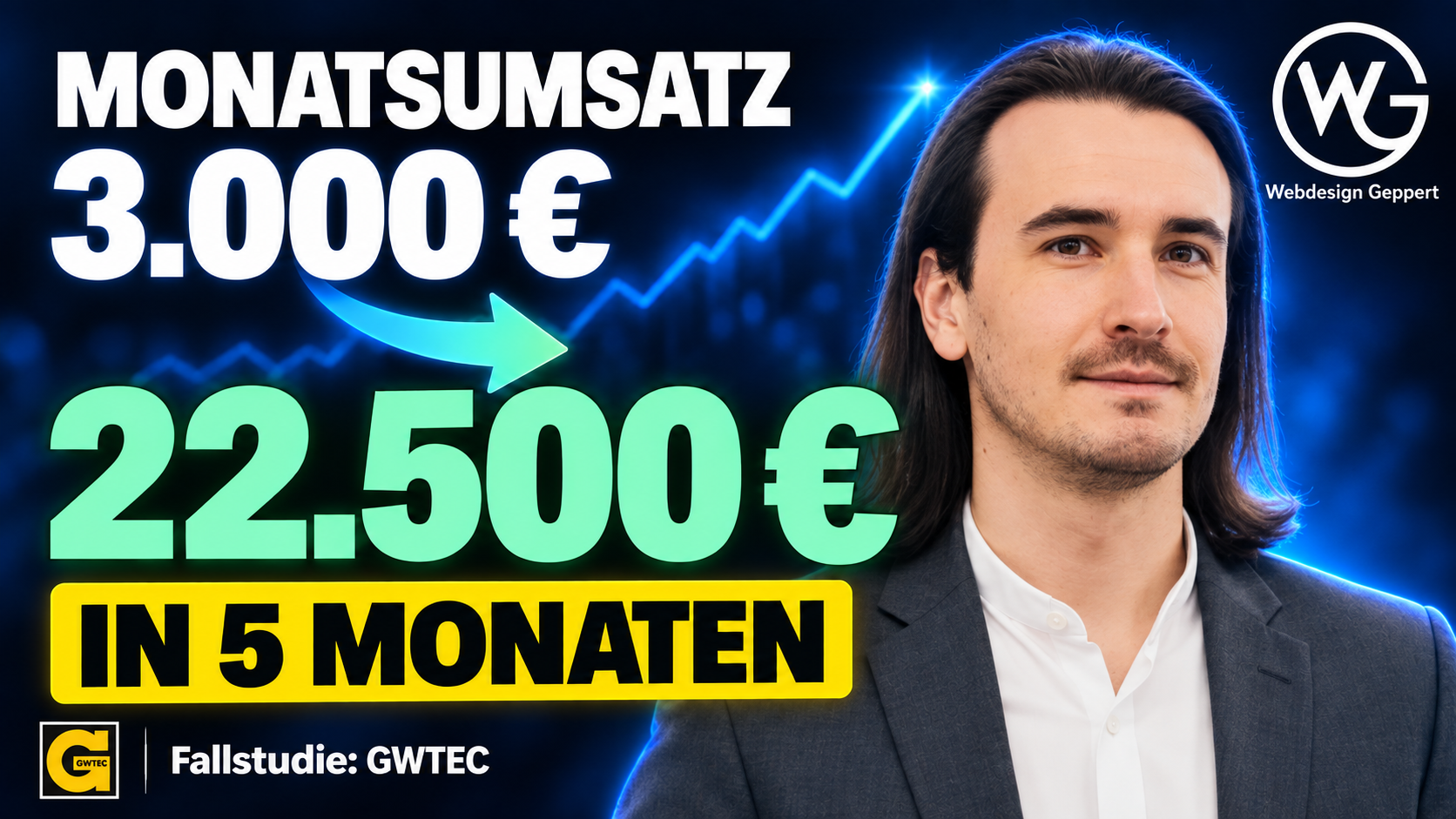
GWTEC: From €3,000 to
€22,500 in monthly revenue.
A WooCommerce store with duplicate products, technical faults and time-consuming order processing. Working with Andreas Brugman, I repaired the foundations, improved product visibility and automated recurring tasks. A troubled side project became a sales channel that GWTEC now wants to grow.
Off-road vehicle parts and accessories · Andreas Brugman, GWTEC · Implementation: Marc Geppert
7.5×
Monthly revenue in August compared with April: €22,500 instead of €3,000. That is an increase of 650%.
Revenue figures from the customer interview with Andreas Brugman. April to August covers five reported calendar months.
What changed
in practice.
The store's technology and design were overhauled. Products became easier to find through Google. Supplier integrations synchronise prices and availability, and electronic invoices are sent automatically.
We started working together in mid-March. The comparison begins in April, after the initial work had already taken place. Andreas reports more orders and phone enquiries, alongside fewer manual checks for each order.
A store migration
that went wrong.
GWTEC builds and services off-road vehicles and sells the corresponding parts and accessories. Its online store had existed for years but was largely a side operation. Moving from Gambio to WooCommerce was intended to create a stronger foundation.
A product import stopped partway through and was then restarted. This left many products duplicated in the store. With the tools available, Andreas could barely resolve the problem. Technical and design work was also unfinished.
“It was practically a total loss,” is how Andreas describes the starting point (translated from German). When I joined in mid-March, the first priority was to make the existing store usable again and ready for further development.
Fix the faults first.
Then build on it.
Repair the product data and structure. I worked through the failed product migration and helped clean up duplicate entries. A technical product range needs accurate categories and relationships: customers must be able to find the right item, and the team must be able to maintain the catalogue.
Improve ordering and payment. I reworked the payment processes and fixed technical faults, broken links and redirects. The priority was the points where a visitor can actually become a customer.
Complete the store. This included implementing cookie consent and privacy information, as well as revising the interface. Andreas describes the new appearance as clearer and more polished. Design, product structure and checkout were addressed together because they work together during a purchase.
Products need
to be found.
SEO and Merchant Center. Alongside the repairs, I worked on the SEO structure and connected Google Merchant Center, which had not previously been set up. Helping customers find the products on Google became a priority alongside making the store work.
Track progress. Andreas followed visibility in Google Search Console himself. In the interview, he reports improving search figures. What mattered most to him was seeing that interest reach the business through orders and phone calls.
“Above all, we noticed it in the orders and the phone calls coming into the business: interest through the online store had become much, much greater.” — Andreas Brugman (translated from German)
According to Andreas, Google ads were not running during this period. Paid advertising was a possible next step. The revenue growth is therefore not presented here as the result of an advertising campaign.
More orders.
Fewer manual checks.
Connect suppliers through APIs. Previously, Andreas had to check whether each ordered item was available and whether its price was still correct. API integrations synchronise prices and availability with supplier data. He can now process orders with less checking and pass them on for fulfilment.
Send electronic invoices automatically. The invoicing process was set up to send the electronic invoice automatically with the order confirmation. Customers no longer have to chase their invoice, and the business avoids a recurring manual task.
Be clear about what comes next. Integration with the separate accounting application was still planned at the time of the interview. It is not included among the completed results described here.
Automation does not replace running the business. Andreas still spends time on order processing, customer contact and advice. It does remove checking and sending tasks that would otherwise repeat with every additional order.
The progress.
Month by month.
Between April and August, reported monthly revenue rose from €3,000 to €22,500. The intermediate figures also show a dip in July; growth was not a straight line.
April
€3,000
May
Over €10,000
June
Around €20,000
July
Around €18,000
August
€22,500
Source: the customer interview with Andreas Brugman and the case study based on it. The approximate figures for May, June and July are retained. These are store revenue figures, not profit.
These figures describe progress during our work together. Technology, visibility, design and GWTEC's work on the product range all contributed. The interview does not establish how much of the revenue increase came from each individual change.
Technical delivery.
GWTEC's industry knowledge.
Working on the catalogue was a joint effort. Suppliers do not automatically deliver data in the structure a specialist retailer needs. I handled the implementation and integrations; Andreas brought his knowledge of vehicles, products and categories.
He added many images himself and improved the categories. That day-to-day expertise mattered in turning imported data into a useful product range. Not every item and category assignment had been fully revised by the time of the interview.
Working directly together meant we could discuss specific problems and agree on the next steps. Andreas did not first have to translate his business requirements into a technical specification.
“I will need you around for a long time yet. You are not allowed to disappear.” — Andreas Brugman (translated from German)
From a side operation
to a plan for the future.
At the time of the interview, Andreas wanted to expand the range from roughly 20,000 products to between 50,000 and 70,000. This expansion was planned, not completed. More suppliers, additional product data and potential future advertising were intended to develop the store further.
In the longer term, he wants to grow online sales into a business opportunity in its own right. That needs more than an attractive store: products people can find, a reliable checkout and processes that can keep up with order volumes.
Those foundations were the focus of our work together. The damaged store became a sales channel whose next steps Andreas is now actively planning.
Hear the story
from Andreas himself.
In the customer interview, Andreas discusses the problems after the store migration, revenue growth and the time saved by the new processes.
Watch the interview on YouTubeThe interview is in German and opens on YouTube. No YouTube player loads automatically on this page.
What is holding
your store back?
Technical faults, low visibility or too much manual work: the free audit looks at the specific obstacles in your store. You receive a clear assessment and practical next steps.